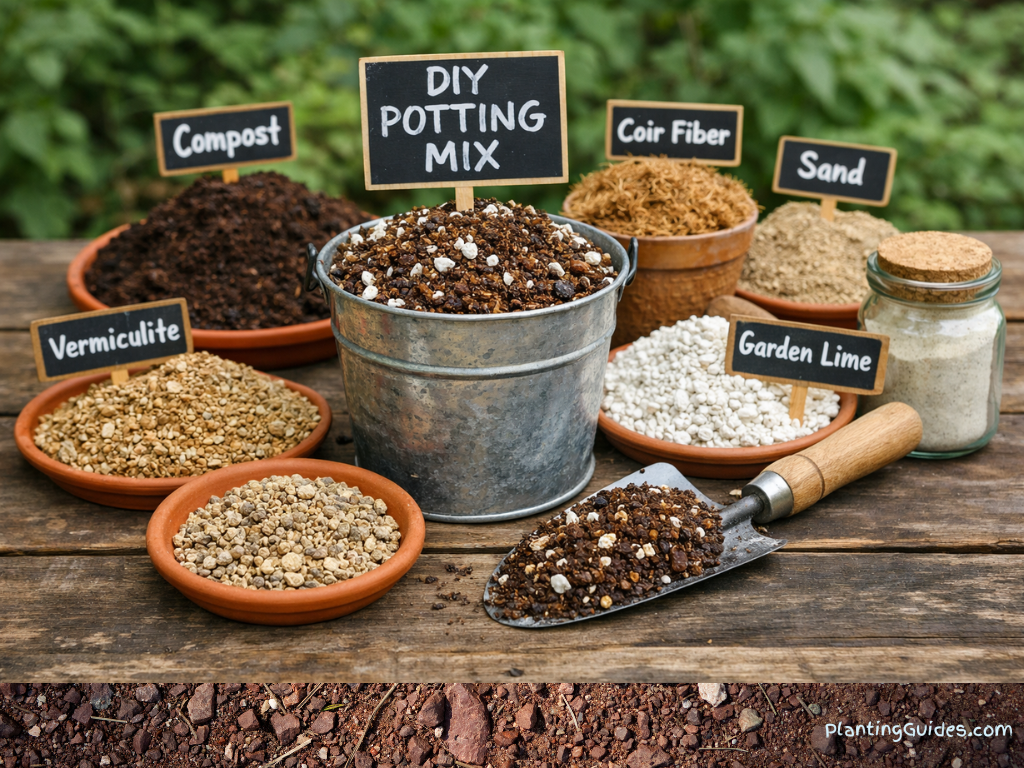
I really like to grow plants in a container. This is really helpful for many gardeners who do not have enough ground space.
If you want healthier container plants, better root growth, and higher yields, the secret starts with the right potting soil mix.
Many gardeners don’t realize that store-bought potting soil isn’t always ideal. Making your own DIY potting mix lets you control drainage, nutrients, and pH, all critical factors for different types of plants.
What Is Potting Soil Mix?
Before I show you my DIY potting soil recipes, you need to know that most potting soil is actually soilless. It's also called Potting Mix. A proper potting mix does not contain garden soil because regular soil:
-
Compacts easily in containers
-
Drains poorly
-
Can introduce pests and diseases
-
Restricts root growth
But a good potting soil mix is designed to:
- Retain enough moisture
- Drain excess water quickly
- Provide oxygen to the roots
- Supply essential nutrients
- Easy to handle and consistent.
- lighter than garden soil.
Essential Ingredients in a DIY Potting Soil Mix
In order to make a perfect potting mix, you need to know about all the Essential Ingredients.
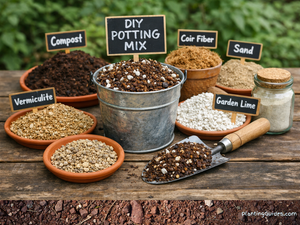
- Peat Moss
This is the primary ingredient for Potting Mix. It improves the Mix structure and excellent moisture retention. But it is naturally acidic (pH 3.5–4.5), so you need to add lime to balance the acidity. - Coconut Coir
Also known as Coir fiber. This is a by-product of the coconut industry. It is used as a sustainable alternative to peat. It can retain water well and more, and it has more nutrients than peat moss. Also, the pH is Near-neutral. But it is more expensive than Peat Moss. - Perlite
Perlite is a type of volcanic rock (small). This improves the mix's drainage and prevents soil compaction. Also, it creates air pockets for root oxygen. It makes the mix more breathable for roots. Also, the pH is Near-neutral. - Vermiculite
Vermiculite is a mined mineral. It increases the mix's porosity. Vermiculite also has natural ingredients like calcium and magnesium, which help the mix's moisture-holding capacity. This is ideal for seed starting. - Compost
Compost is an excellent ingredient for a potting mix. It adds all the necessary ingredients to mix. It improves microbial activity and enhances the soil structure. - Fertilizers
If you are using Peat Moss for the mix, then adding Fertilizers is must for you. Because peat moss does not contain enough nutrients for plants. You can use your homemade organic fertilizer. - Sand
It is used to improve the drainage and increase the weight of the mix. - Lime
Lime is generally used to raise the pH of the mix in case you are using Peat Moss in your mix. Although it prevents nutrient lockout and supplies calcium and magnesium.
So, these are the essential ingredients for a Potting Mix. Now I am going to share my own potting recipes for different use cases.
DIY Potting Mix recipes
| Mix Type | Main Ingredients (Gallons) | Drainage | Nutrient Level | Lime Needed? |
|---|---|---|---|---|
| General Potting Mix | Peat/Coir (6) + Perlite (4.5) + Compost (6) + Fertilizer | Medium | High | Yes (if peat) |
| Trees & Shrubs Mix | Compost (3) + Sand (2.5) + Peat/Coir (3) + Pine Bark (2.5) + Perlite (3) | Medium-High | Medium-High | Yes (if peat) |
| Succulent & Cactus Mix | Peat/Coir (3) + Perlite (1) + Vermiculite (1) + Sand (2) | Very High | Low | Yes (if peat) |
| Seed Starting Mix | Peat/Coir (2) + Vermiculite (2) + Sand (1) | Medium | Very Low | Yes (if peat) |
| Transplant Mix | Peat/Coir (2) + Vermiculite (2) + Compost (1) + Fertilizer | Medium | Medium | Yes (if peat) |
| Houseplant Mix | Peat/Coir (2) + Perlite (1.5) + Sand (small) + Fertilizer | Medium | Medium | Yes (if peat) |
How Much Lime Is Typically Added?
If you are using peat moss, this question will come to your mind.
So here it is:
2–3 tablespoons per batch, or ¼ cup for large batches.
Why am I not using potting mix in a raised bed?
The reason not to use potting mix in a raised bed is that it’s usually WAY more expensive than topsoil, and it’s not meant for large areas. It can hold onto too much moisture and compact too much.
If your raised beds are large, you don’t need potting mix. Potting mix is good for containers, though I grow my tomatoes in potting mix in 15-gallon containers. My garden beds have topsoil and compost.
If you are going to build raised beds, I suggest layers. Wood on the bottom, twigs, leaves, or mulch, straw, water, soil, I use a mix of garden soil, perlite, vermiculite, black cow, Pete moss, worm castings.
I fertilize every couple of weeks during my grow season with egg shells, Epsom salts, and test for acidity. Sometimes I need more black cow, nitrogen, and more calcium due to rain.
I have never had such an amazing garden as I've had with the raised beds. On the other hand, during heavy rains, I have learned to catch the dip in minerals and treat my plants right away.
That's something that doesn't happen to gardens on the ground as often. The nice thing is that raised beds extend the growing season.