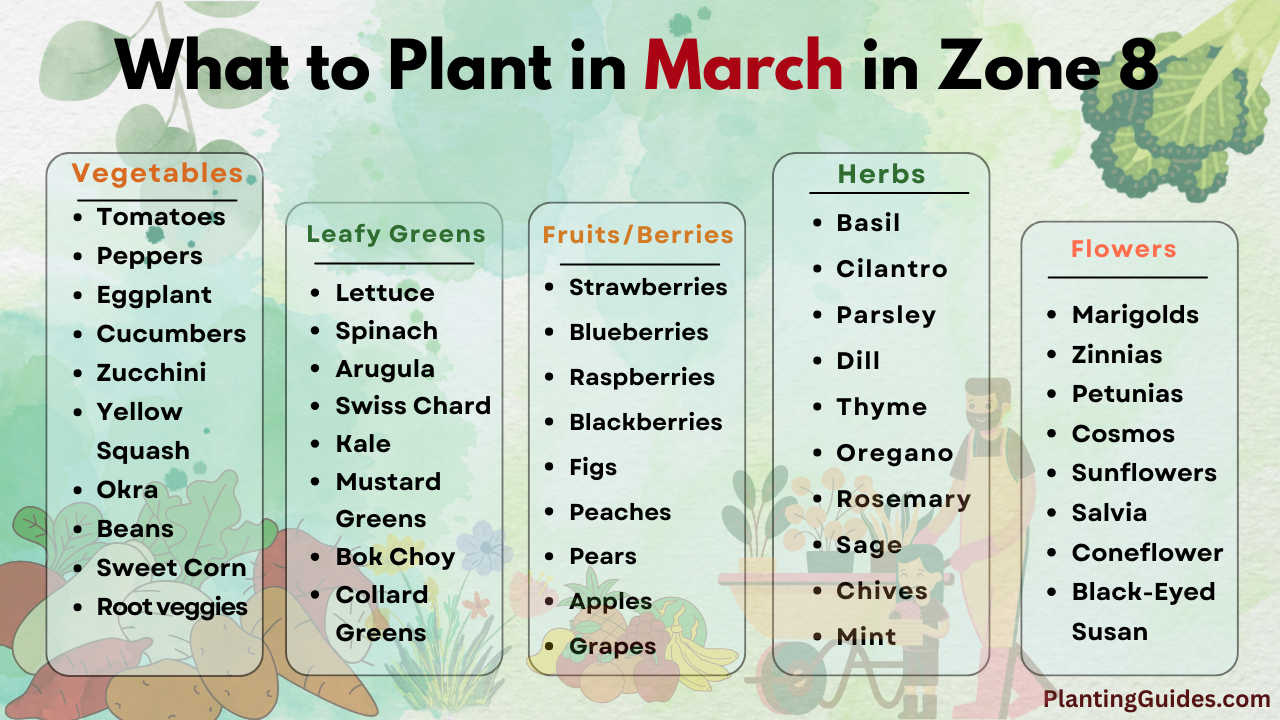
If you garden in Zone 8, March is not "almost spring."
It is spring.
The weather finally starts to feel warmer, and you can actually notice the change. The soil isn't cold and stubborn anymore — it's slowly warming up and getting ready for planting, which helps seeds sprout and grow stronger.
This month gives you one big advantage:
This month in Zone 6, you can plant both cool-season and warm-season crops successfully.
That means you have more options and more chances to grow a productive garden.
Frost risk is low, but not ZERO. The average last frost in Zone 8 is Early–Mid March.
So this is the time when you move fully into the growing season. Now, let's see what you should plant this month.
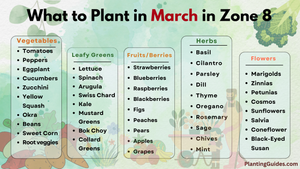
Leafy Greens to Plant in March in Zone 8
In Zone 8, leafy greens grow fast in March. Sow the seeds about ½ inch deep and keep the soil lightly moist.
Add a thin layer of compost around the base of your plant. It will improve flavor and help the plant grow faster.
| Leafy Green | Planting Method | Transplanting Time (Days After Sowing) | First Harvest | Variety Suggestion |
|---|---|---|---|---|
| Lettuce (leaf, romaine, butterhead) | Direct sow or start indoors | 21–28 days | 30–50 days | Buttercrunch, Jericho, Black Seeded Simpson |
| Spinach | Direct sow outdoors | Not recommended | 30–40 days | Bloomsdale, Space |
| Arugula | Direct sow outdoors | Not needed | 25–35 days | Astro |
| Swiss Chard | Direct sow or start indoors | 21–25 days | 50–60 days | Bright Lights |
| Kale | Direct sow or start indoors | 25–30 days | 45–60 days | Lacinato, Red Russian |
| Mustard Greens | Direct sow outdoors | Not needed | 30–40 days | Southern Giant |
| Bok Choy | Direct sow outdoors | Not needed | 30–45 days | Joi Choi |
| Collard Greens | Direct sow or start indoors | 25–30 days | 55–75 days | Georgia Southern |
✘ Don't pull out the whole plant once the leaves are mature.
Just pick the outer leaves and keep harvesting often. This way, the plant will continue to grow and give you fresh leaves for many weeks.
If you want quick results, plant lettuce and arugula. They grow fast and make you feel like a gardening expert.
Vegetables to Plant in March – Zone 8
This is the time when Zone 8 gardeners do their best.
In March, plants build strong roots before the summer heat. After the last frost, usually by mid-to-late March, you can start planting warm-season crops directly in the garden.
| Vegetable | How to Plant | Spacing | Care Tip | First Harvest | Variety Suggestions |
|---|---|---|---|---|---|
| Tomatoes | Transplant seedlings | 18–24 inch apart | Bury stem deep for stronger roots | 60–85 days | Roma, Cherry, Beefsteak |
| Peppers | Transplant seedlings | 18 inch apart | Plant only in warm soil | 70–90 days | Bell, Jalapeño, Cayenne |
| Eggplant | Transplant seedlings | 18–24 inch apart | Needs full sun | 70–90 days | Black Beauty, Japanese |
| Cucumbers | Direct sow or transplant | 12 inch apart | Install trellis at planting | 50–70 days | Marketmore, Lemon, Persian |
| Zucchini | Direct sow | 2–3 ft apart | Give space — plants get big | 45–60 days | Black Beauty, Costata |
| Yellow Squash | Direct sow | 2–3 ft apart | Harvest small for best taste | 45–60 days | Early Prolific |
| Bush Beans | Direct sow | 3–4 inch apart | Do not soak seeds | 50–60 days | Blue Lake, Contender |
| Pole Beans | Direct sow | 6 inch apart | Set up support first | 60–70 days | Kentucky Wonder |
| Sweet Corn | Direct sow in blocks | 8–12 inch apart | Plant in rows, not single row | 70–90 days | Silver Queen |
| Okra | Direct sow (late March) | 12 inch apart | Loves heat | 50–65 days | Clemson Spineless, Emerald |
Soil temperature should be 60°F+ for tomatoes and peppers.
I always harden off my indoor seedlings for about a week before planting outside.
Plant seedlings in the morning or evening, not in the middle of the day. The spring sun can be too strong for new plants until their roots are settled.
Root Vegetables
March soil in Zone 8 is loose and workable, perfect for roots to grow strong and healthy.
| Vegetable | How to Plant | Spacing | Care Tip | First Harvest | Variety Suggestions |
|---|---|---|---|---|---|
| Carrots | Direct sow | Thin to 2 inch apart | Keep soil moist until sprouting | 60–75 days | Nantes, Imperator |
| Beets | Direct sow | 3 inch apart | Thin early | 50–60 days | Detroit Dark Red, Golden |
| Radishes | Direct sow | 2 inch apart | Fast grower | 20–30 days | Cherry Belle, French Breakfast |
| Turnips | Direct sow | 4 inch apart | Harvest before oversized | 40–60 days | Hakurei, Purple Top White Globe |
| Potatoes | Plant seed potatoes | 12 inch apart | Plant 4 in deep | 80–100 days | Yukon Gold, Red Pontiac |
I always try to plant these in the first week of March to give them the best chance to grow strong and healthy.
Herbs to Plant in Zone 8
Herbs like parsley, cilantro, and chives grow really well in the cool, mild March weather.
| Herb | Planting Method | First Harvest | Variety Recommendations | Flavour |
|---|---|---|---|---|
| Basil | Sow indoors or transplant seedlings | 30–50 days | Genovese, Sweet Thai | Sweet, aromatic |
| Cilantro | Sow seeds outdoors | 40 days | Santo, Calypso | Fresh, citrusy |
| Parsley | Sow indoors/outdoors or transplant | 70 days | Italian Flat Leaf, Curly | Mild, grassy |
| Dill | Sow seeds outdoors | 40–60 days | Bouquet, Dukat | Tangy, grassy |
| Thyme | Transplant or divide plants | 60 days | English Thyme, Lemon Thyme | Earthy, lemony |
| Oregano | Transplant or divide plants | 60 days | Greek, Italian | Strong, pungent |
| Rosemary | Transplant seedlings | 60 days | Tuscan Blue, Arp | Piney, aromatic |
| Sage | Transplant seedlings/cuttings | 70 days | Common, Purple | Earthy, savory |
| Chives | Sow or transplant seedlings | 60 days | Common, Garlic Chives | Mild, oniony |
| Mint | Plant divisions/cuttings | 60 days | Spearmint, Peppermint | Cool, refreshing |
These herbs need 6–8 hours of sun every day. Some, like parsley, can handle a little shade.
I always give my herbs 6–12 inches of space so they get good airflow and stay healthy.
Flowers to Plant in March in Zone 8
Flowers grow quickly in warm spring soil.
| Flower Name | Planting Method | First Bloom | Perennial or Annual | Flower Color | Sunlight |
|---|---|---|---|---|---|
| Marigolds | Sow seeds or seedlings | Late spring | Annual | Yellow/Orange | Full sun |
| Zinnias | Sow seeds directly | 60 days | Annual | Red/Pink/Yellow | Full sun |
| Petunias | Start seedlings | Spring | Annual | Purple/Pink/White | Full sun/Partial |
| Cosmos | Sow seeds directly | 60–70 days | Annual | Pink/White/Red | Full sun |
| Sunflowers | Sow seeds directly | 70–90 days | Annual | Yellow/Brown | Full sun |
| Salvia | Start seedlings | Late spring | Perennial/Annual | Red/Purple/Blue | Full sun |
| Coneflower | Start seedlings | Summer | Perennial | Purple/Pink | Full sun |
| Black-Eyed Susan | Sow seeds directly | Summer | Perennial | Yellow/Black center | Full sun/Partial |
Give each plant enough space, about 6–12 inches, for good airflow.
Water your flower plants deeply once or twice a week, instead of every day.
Petunias, Salvia, and Coneflower should be transplanted outdoors after the last frost when they have 3–4 true leaves.
Fruits & Berries
Here are the best fruits and berries to plant in Zone 8 this month, with tips on how to plant them, when you can harvest, their usual height, and the best varieties to try.
| Fruit/Berry | Planting Method | First Harvest | Plant Height | Variety Recommendations |
|---|---|---|---|---|
| Strawberries | Plant bare-root crowns or small transplants | Late spring of same year | 6–12 inches | Chandler, Albion, Seascape |
| Blueberries | Plant potted or bare-root shrubs | 2–3 years | 3–6 feet | Bluecrop, Sunshine Blue, Legacy |
| Raspberries | Plant dormant canes | Summer, same year for primocanes; next year for floricanes | 4–6 feet | Heritage, Caroline, Fall Gold |
| Blackberries | Plant dormant or potted canes | Year 2 | 5–8 feet | Ouachita, Apache |
| Figs | Plant small potted or bare-root trees | 1–2 years | 10–30 feet | Brown Turkey, Celeste |
| Peaches | Plant bare-root trees | 2–3 years | 15–25 feet | Elberta, Redhaven |
| Pears | Plant bare-root trees | 3–4 years | 15–20 feet | Bartlett, Kieffer |
| Apples | Plant bare-root trees | 2–4 years | 10–25 feet | Gala, Fuji, Honeycrisp |
| Grapes | Plant bare-root vines | Year 2–3 | 6–10 feet (vine) | Concord, Flame Seedless |
| Black Currants | Plant bare-root shrubs | Year 2 | 4–6 feet | Ben Lomond, Titania |
| Gooseberries | Plant bare-root shrubs | Year 2 | 3–5 feet | Captivator, Hinnomaki Red |
From my experience, fruit plants do best in soil that drains well because they hate sitting in water.
I always put mulch around my plants after planting to keep the soil moist and stop weeds.
I also water my new fruit plants deeply once or twice a week, depending on the rainfall.